The Girl Who Fell Through the Cracks in a System and How to Avoid this Happening in Your Organization
Power Principle: Every broken system has a gap where power leaks. Mind the gap.
If you have ever ridden the London Underground — the Tube, as Londoners call it — you may have heard the announcement drone over the loudspeaker: “Mind the gap.” The gap is not a chasm. It is just a few inches of empty space between the edge of the train and the edge of the platform, and it has caused enough falls to warrant a routine, repeated warning. Pay attention. Don’t trip on the gap.
Most institutional failures work the same way. They don’t appear in the visible machinery of bureaucracy. They appear in the narrow space between thought and action — between what a policy says it will accomplish and what a caseworker does in a suburban living room. That is where the gap opens: between what a system is designed to do, and how it actually functions on the ground, under pressure, with no one watching.
Eight-year-old Gracie lived in that gap, the way millions of American children navigate the geography of shared custody. Gracie’s mom had made the difficult decision to leave her husband, to protect herself and her children from ongoing domestic violence. Shockingly, family courts still tend to believe that violence toward a mother doesn’t raise the odds of violence toward her children. So Gracie kept crossing the threshold on the days the custody order required it, still living in the uncertainty that children in these situations carry in their bodies long before they have words for it.
During one of those visits, an argument escalated the way arguments in volatile households do — unpredictably, and fast. Words turned sharp. Tempers broke. Gracie’s father grabbed her by the neck. She yelled in protest, and he stopped.
Gracie told her counselor. The counselor reported it. A Child Protective Services (CPS) caseworker came to the mother’s home. He interviewed Gracie. He interviewed her younger brother separately. In the next room, Gracie’s mother heard both children tell the same story.
The CPS assessment was dismissed. Custody proceeded unchanged. In fact the false CPS report was used against the mother in a Protective Order trial against the father on behalf of a different child just one month later as grounds that false reports were being made in the family and this other child was not to be believed. This was a protective order trial where there was 911 audio evidence of the father trying to cast a demon out of Gracie’s 7-year old sister.
Gracie’s mom couldn’t understand what had happened. A CPS investigation was never even opened - it never rose above the initial family assessment because this initial screening had been falsified. Months later when the case , she requested a copy of the official case file.
The written summary did not describe a father grabbing his daughter’s neck. It described a father grabbing his daughter’s arm. One word. And in that substitution — quiet, uncorrectable, buried in a bureaucratic record that courts and agencies would treat as authoritative — Gracie’s voice had been erased. Not necessarily out of malice. More likely because a caseworker’s own judgment overrode her testimony, in a system with no mechanism for anyone to ever check. With a few strokes of a pen, her case was logged as unfounded.
The gap had spoken. Gracie fell right through it. You can watch the 2 minute Congressional testimony about her story here.

Why I couldn’t let it go
I know Gracie. I know her mother. I know the family well. And when I first heard what had happened, I couldn’t set it down — which was unusual for me. I’ve spent years in this work, in some sense since childhood. My father was an FBI agent who worked human trafficking and kidnapping cases, and growing up, he’d ask our family to pray by name at the dinner table for missing children — public cases he knew personally.
My parents were also foster parents. I was a foster sibling. Long before I worked professionally in advocacy, I was already accompanying women to the courthouse pro bono, helping them secure protective orders, sitting beside them as they tried to leave violent situations. Gracie’s story was personal in a way I couldn’t compartmentalize.
Every morning I have a ritual: tea, quiet, prayer — a version of what some call meditation, though not a very disciplined one. It’s my chance to pour out whatever is weighing on me, then let it go. But Gracie’s story kept coming back. It wouldn’t release me until I did something about it.
One morning, in that quiet, the story replayed again, and I asked myself: what would have made this outcome different? The answer arrived immediately. If Gracie’s interview had been recorded, the gap never opens, and she never falls through it. Surely someone has already solved this, I thought — it’s such an obvious fix, some state must already require it. And then: if nobody else has done this, why don’t you?
I started researching. I ran the academic search, but I also got on the phone with an FBI investigations trainer and with leading legal minds working these cases across multiple states. What I found surprised nearly everyone I spoke to: no state was doing this. Police wear body cameras. Doctors record office visits. But the initial CPS interview — the one that decides whether a case moves from a family assessment to a full investigation — ran almost entirely on trust in the caseworker’s written summary. No recording. No documentation to check it against. No way for a supervisor to review, train, or correct an interview after the fact.
Can you imagine a Senator giving a speech in Congress with no camera, no stenographer, no witnesses — just one stranger writing a summary, which then becomes the official record used to shape policy? Or imagine being accused of a crime and knowing the only account of your police interview is whatever the officer decided to write down. Now consider that 37.4% (more than 1/3) of American children are interviewed by CPS every year, and almost none of those interviews are recorded or subject to any check at all. ZERO states require recording of initial interview by CPS. My doctors in Northern Virginia even audio record routine office visits. The gate to foster care is effectively unlocked. Why? To protect the abusers and the employees of CPS.
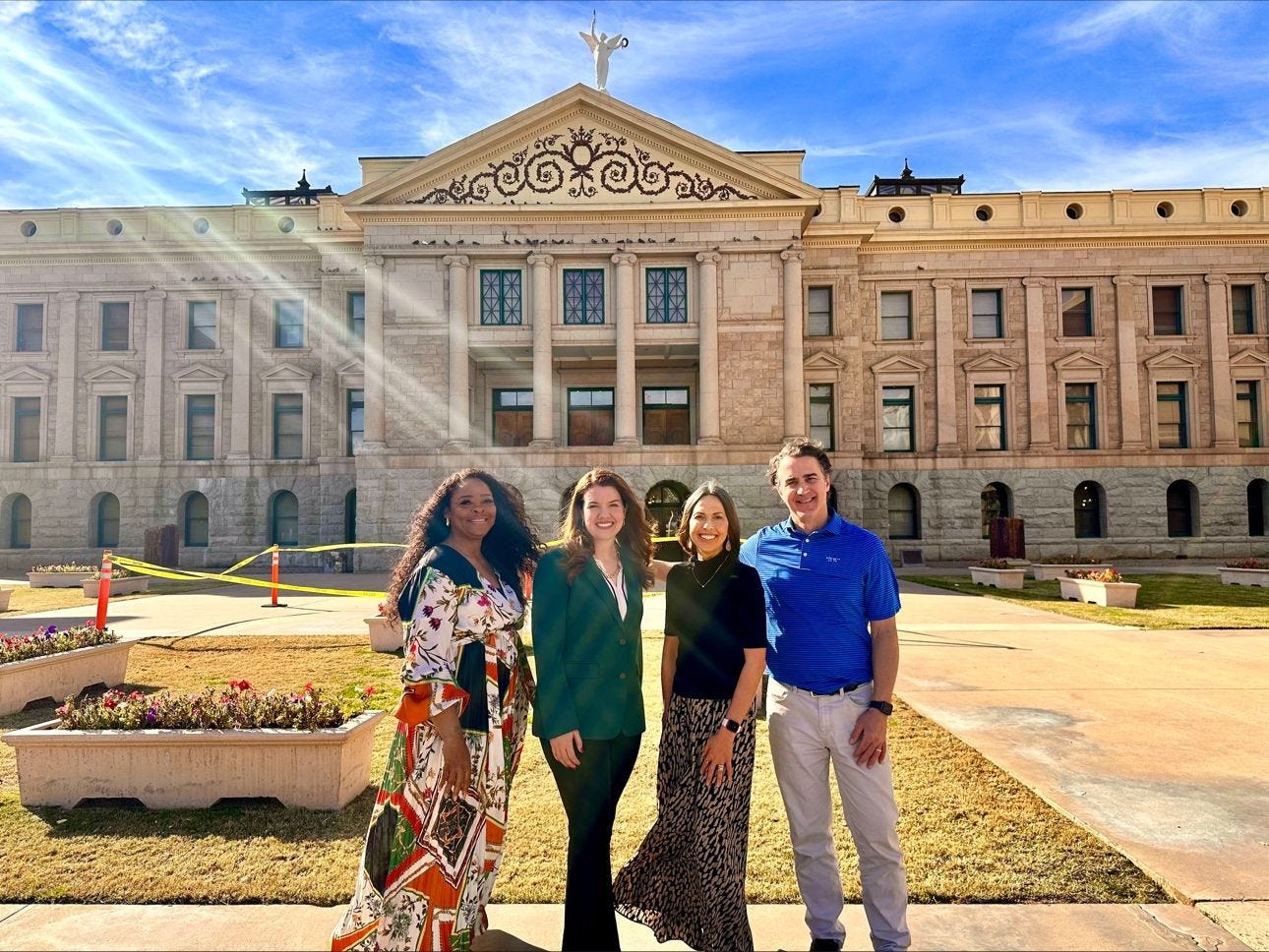
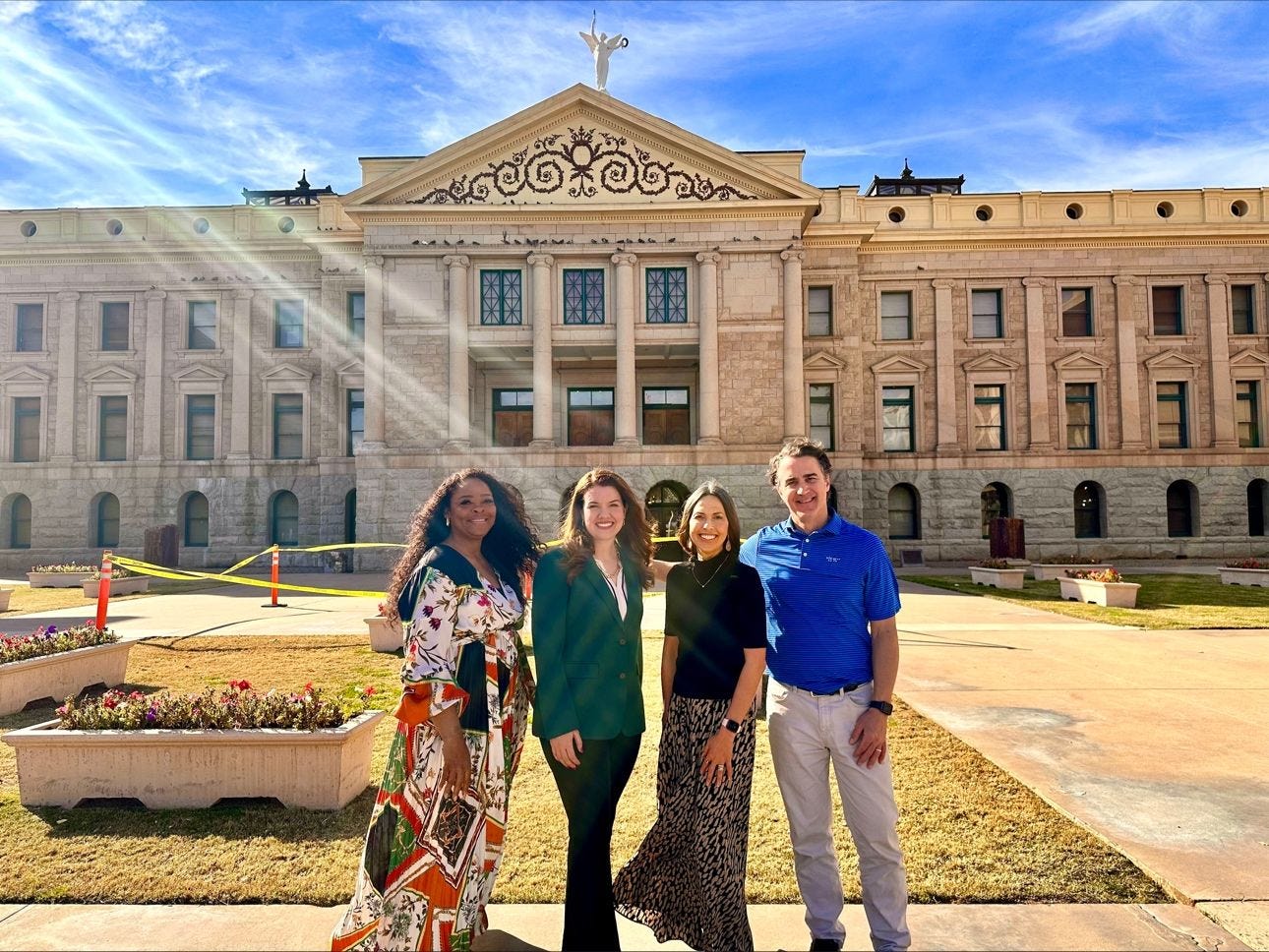
2024: With survivors and advocates at the Arizona state legislature - the first state to introduce a bill in 2024 (passed unanimously through the first committee that day).
The gate nobody was watching
Every child who enters foster care passes through CPS first. That initial interview is the gate — the threshold between a child staying with her family and a child entering a system that is extraordinarily hard to leave. It’s the moment when a caseworker’s perception, bias, fatigue, or indifference can become official record, with no crosscheck. No camera. No witness. An account can be softened, sharpened, or simply lost to bad note-taking, and there is no way back — no way to ask, is this what she actually said?
Nearly every proposed fix to the foster care system — better training, better placements, stronger reunification programs — targets what happens after the gate. After the child is already inside. After the record has already been written and the moment that determined everything has already vanished without a trace.
Recording the initial interview doesn’t undo what happened to a child. But it determines what can later be known, challenged, and corrected. It is the simplest possible accountability mechanism — and the one that should have existed first, before any other reform.
I built a small coalition, including the organization I worked for at the time, and we began exploring an executive order through the White House. Then COVID hit and the world shut down. I moved to the Department of Justice’s Office for Victims of Crime as Senior Advisor. Eventually I left DOJ and started my own firm, Ascend Consulting DC. One of my former grantees at DOJ, Street Grace, became a client — and its founder, Cheryl DeLuca-Johnson, was passsionate about the concept for a bill.
Cheryl’s investment turned out to be deeply personal. She had foster-adopted two elementary-school-aged children, and she could never fully learn the story of their trauma, because almost no records existed. Their outcomes might have looked very different if there had been a record of what they’d said, back when they still remembered it.
A CPS interview is not a casual conversation. It is often the single most consequential encounter a vulnerable child will have with the very system meant to protect her. The conclusions shape custody decisions, court proceedings, agency reviews — and sometimes whether a child lives or dies. One of the most common findings in child-fatality audits is that CPS had interviewed the children multiple times and taken no action. The entire downstream system pivots on what that interview records. And yet the interview itself — the child’s actual words — disappears the moment the caseworker closes her notebook, often after interviewing the child alone, with no witness and no other safeguard in the room.
The Department of Justice records interviews. Police departments record interviews. Recording has been considered best practice for child forensic interviews since 2015, and more than 900 Child Advocacy Centers across the country wouldn’t dream of interviewing a child without one. The technology isn’t exotic or expensive. But Child Protective Services, in every state in the country, has operated without it.
This was the gap Gracie and her family fell into. And on a Tuesday morning in February 2025, after years and countless cups of morning tea, I walked into a congressional hearing room carrying her story — a brown-haired, brown-eyed girl who’d once won the “Miles of Smiles” award in first grade, before the divorce.
I held up a copy of the Congressional Record from a single day of House floor speeches — every word preserved for accuracy and posterity. “What if you, as Members of Congress, gave an important floor speech, and it was never recorded?” I asked. “What if the only witness in the room wasn’t a stenographer, but one observer, writing a personal analysis of your testimony? Would you accept that as an accurate record of what you said? Do you want the most important statements of your life left to the mercy of one stranger with a pen? Police are required to wear body cameras in most states. The Department of Justice has mandated interrogation recordings since Attorney General Eric Holder. But child victims aren’t given the same protection.”
I asked members to support the GRACIE Act — named for the girl who inspired it, and standing for Generate Recordings of All CPS Interviews Everywhere. It would incentivize CPS agencies to record initial interviews creating a record of truth. It wasn’t radical. It was a tweak — a request that the system catch up to the twenty-first century.
Congress listened. State legislatures listened. There was bipartisan agreement that this gap needed closing. As of this writing, Congress and nine states have introduced legislation addressing it, and Virginia and Arizona have passed unanimously through very purple legislatures (the Governors in both states vetoed - citing funding concerns which are minimal). If you would like to learn more about the GRACIE Act coalition, please let me know or sign up here.
Power Principle
Every broken system has a gap where power leaks. Mind the gap.
Make the gap visible. Most gaps persist not because people don’t care, but because they’ve never been forced to see them clearly. A statistic can open a door. A story walks you through it.
Articulate a workable solution. Outrage without a destination is just noise. Your solution doesn’t have to be perfect. It has to be possible.
Mitigate risk for supporters. Understand the cost of what you’re asking before you ask it. Make the path to yes feel shorter than the path to no.
Build a coalition. Breadth and expertise signal legitimacy. Decisions questioned when one person asks them become harder to question when a room full of credible voices asks together.
In Part 2, I’ll break down the framework used to move GRACIE — and how the same playbook applies to closing gaps in a boardroom, an org chart, or any system that’s quietly failing the people inside it.
Originally published in How Power Moves on Substack: https://howpowermoves.substack.com/p/mind-the-gap-part-1-the-girl-who