Oversharing Builds Trust
What a rooster at DOJ taught me about vulnerability in a professional setting.
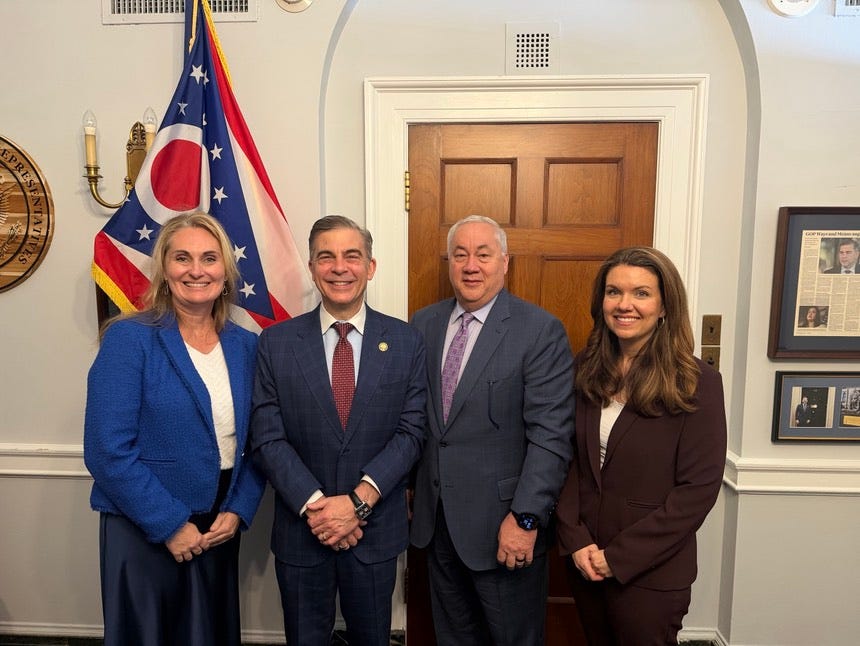
Washington, D.C. is the most buttoned-up city in the world. The armor goes on before you leave the house — the pressed suit, the rehearsed talking points, the carefully calibrated answer to every question you can anticipate. In a city built on managing perception, vulnerability can feel like a liability.
I’ve learned, though, that the armor can be costly — in government and in business. Some of the most important moments in my career happened not when I stuck to the talking points, but when I set them down.
What happens when we disclose
I was once in a meeting making the case for a bill with a senior member of Congress. I told the story, laid out the key points, made the ask — and he still did not seem engaged. I could feel the meeting slipping toward a polite, forgettable end.
So I decided to share something personal that was relevant to the bill: my parents were foster parents, I was a foster sibling, and I had watched children navigate systems that were not designed to hear them. The temperature in the room shifted. I could tell he was focused in a way he hadn’t been a moment before.
Researchers call that shift the trust signal. When you reveal something personal, the listener’s brain updates its assessment of you — and not downward, as most of us instinctively fear. Upward.
The Research Behind the Oversharing
Leslie John, a behavioral scientist at Harvard Business School, has spent over a decade documenting this pattern. Her research consistently finds that the bigger risk in a conversation is not oversharing. The bigger risk is undersharing. What feels, in the moment, like too much information is often just the honest version of the conversation the other person was also hoping to have.
Brené Brown arrived at a similar conclusion about vulnerability from a completely different direction. Her research on connection found that the people with the strongest relationships shared one distinguishing characteristic: they were willing to be seen.
For leaders, this is a practical challenge because we have all been trained to do the opposite. We are trained to project certainty, to appear confident, to never let the other side see a gap in our armor. But certainty generates distance, and distance does not close deals or pass legislation. It can make a high-stakes meeting feel professional and forgettable.
The Rooster at DOJ
During COVID I was the Senior Advisor for a large office at the Department of Justice. Most of the staff was working remotely, so we decided to host a virtual one day “retreat.” The feedback after the event exceeded my expectations. In reflection I believe it was because the opening ice breaker set the tone for vulnerability and respect in the breakout sessions throughout the day. Most of us probably dread ice breakers if we’re honest, but in this context it created a space for vulnerability and oversharing in an office full of attorneys and heavy issues.
On camera everyone had to showcase a personal object from their home or reveal a hidden talent. The stories were moving, inspirational and hilarious. The crowning disclosure was when someone popped on camera with a rooster. This was one of the most senior respected leaders in the office, and she lived in a busy DC suburb like the rest of us. She shared where the rooster lived in her townhouse and how they kept it from crowing early in the morning, all while stroking the bird like a cat in her lap!

I’ve watched the same dynamic play out in smaller moments. In the early days of COVID lockdowns, I once disclosed to a colleague on a Zoom call that the back half of my hair was still wet because I’d only had time to blow-dry the front before the meeting started. She laughed and admitted she’d done the same thing. That thirty-second exchange did more for our working relationship than months of polished professionalism.
The Pratfall Effect
This principle translates directly into business. Companies that proactively disclose the limitations of their own products — the tradeoffs, the things that still need work — consistently outperform companies that maintain a flawless external narrative.
This is known as the Pratfall Effect, a finding dating back to research from the 1960s: a person or product that reveals an imperfection is perceived as more trustworthy, and counterintuitively more competent than one who presents without flaw. Perfection signals concealment. Imperfection signals confidence — because only someone genuinely confident in the core value of what they’re offering can afford to admit where it falls short.
Leslie John’s research illustrates the stakes of this concretely. When participants were given a choice between a candidate who disclosed something embarrassing and one who simply said “I choose not to answer,” they consistently chose the one who overshared. The refusal to answer registered as concealment. The willingness to be vulnerable registered as trustworthy. We would rather take a chance on the person who was honest with us than bet on the person who managed us.
When Oversharing is Catastrophic
None of this is a license for bold, unfiltered overly emotional confessions or turning on internal alarms in the listener that distract from your message. Sharing too much personal information or giving too many details to a story can be catastrophic and eclipse the overall message of course. The point is obviously not to cross the line into creating a therapy session.
That’s why it requires judgment: knowing which piece of your own story is relevant to the moment in front of you, and being willing to offer it. The foster care disclosure worked because it increased credibility and directly connected to the policy in discussion - it wasn’t overly emotional or creating internal alarms in the listener. The rooster disclosure built trust because it brought levity and personality to otherwise heavy topics and gave listeners a window into the world of the leader that no amount of polished talking points would have revealed.
Why This Matters More in High-Stakes Rooms, Not Less
There’s a common assumption that high-stakes rooms — Congressional offices, board meetings, investor pitches — are the wrong place to let your guard down, and that vulnerability belongs in more casual, lower-stakes settings. My experience says the opposite. The higher the stakes, the more the room is full of people who have been pitched, lobbied, and managed constantly, by everyone, for years. They can detect polish from across the room, because polish is what they get all day, every day.
What they don’t get all day is the truth, delivered plainly, by someone willing to be seen. That is what shifted the temperature in the room with that senior member of Congress. That is what focused the attention of the members at the roundtable. It wasn’t a technique. It was the simple, disarming fact of honesty in a room that had learned to expect its opposite.
In the room where decisions get made, being vulnerable and authentic is worth the risk.
Where do you draw your own line between authentic disclosure and oversharing in a professional setting? Has there been a moment when revealing something personal changed how a meeting, a pitch, or a negotiation went?
Originally published in How Power Moves on Substack: https://howpowermoves.substack.com/p/oversharing-builds-trust