
Power Moves: How working for Senator Jon Kyl was a masterclass in the leadership skills AI can’t replace
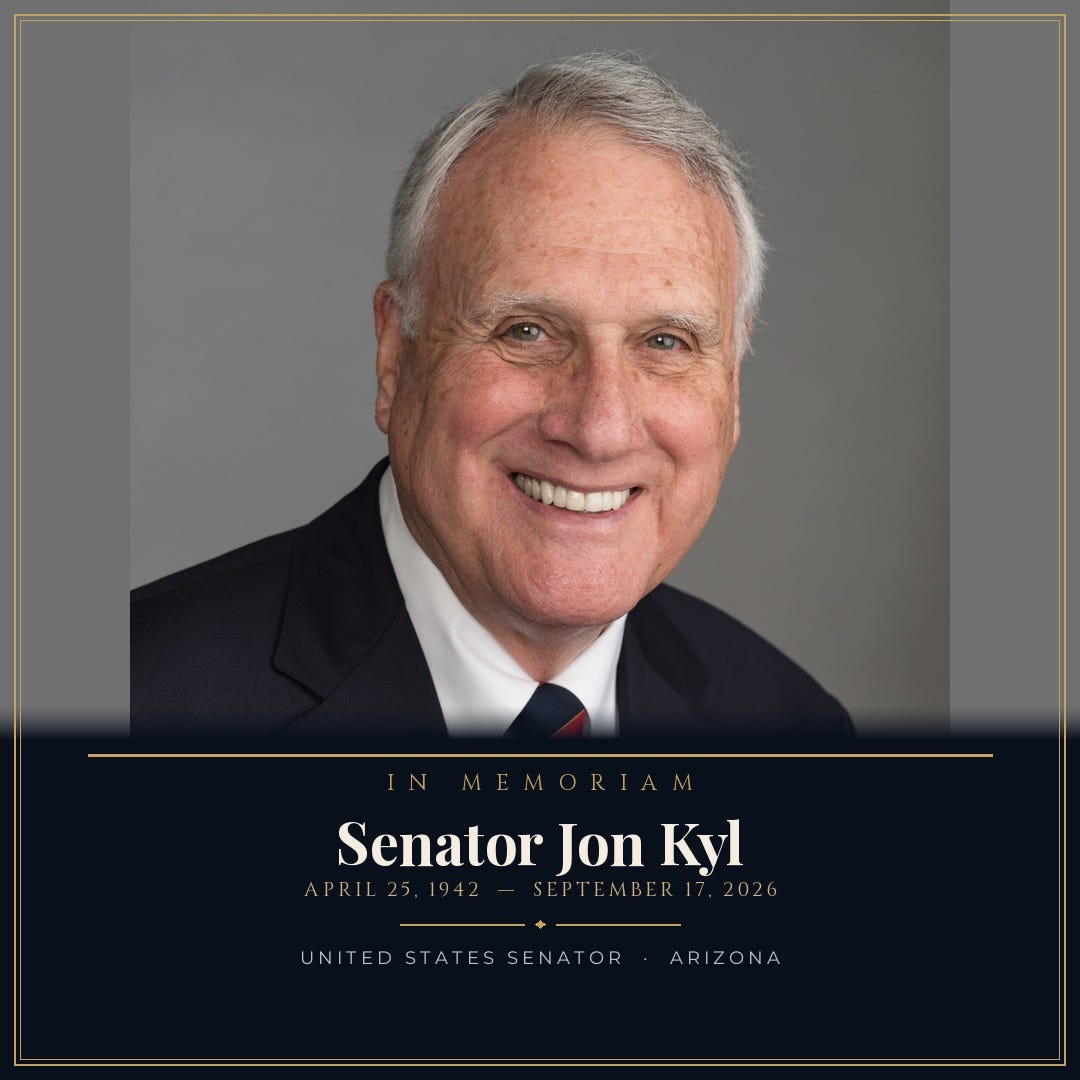
I was twenty years old when I first saw an internship listing for his office in an ASU binder. I had no idea that one decision would set the course for the rest of my career. I worked for Senator Jon Kyl for several years — driving him to events, staffing him in meetings, reading his feedback, watching him think. He passed away this week at 84 - fittingly on Constitution Day.
Without him, I wouldn’t be writing to you here today. I wouldn’t even have a love for policy. I had lived in the Washington, DC area much of my childhood, and I definitely did not have “Potomac Fever” as they call it - the allure work in the most powerful government institutions in the world. My entire jaded perspective on politics changed by working up close with him. Everything in my career traces back to that binder, that internship, and the years that followed.
To this day, I still think: what would Jon Kyl do?
Here are the lessons from his life that I come back to most — lessons in leadership taught through his life not a lecture.
1. Unity is not agreement.
I watched him work across the aisle with Senator Dianne Feinstein and many others effectively to pass massively significant legislation, and it taught me what unity actually means. It’s not agreement — it’s mutual respect. You can hold your position and still respect those who holds the opposite one. That’s harder than it sounds, and very few political leaders in Washington actually do this. He did it for decades. He proved you can hold to your convictions, be successful in your endeavors, and not be considered a lightning rod.
2. Speak up for those who cannot speak up for themselves.
I watched the Crime Victims’ Rights Act (CVRA) move through negotiations in real time. The CVRA established a formal set of legal rights for victims in federal criminal cases — including the right to be notified of and present at court proceedings, to be heard at plea and sentencing hearings, and to be treated with fairness and respect for their dignity and privacy. It gave victims standing to actually assert and enforce these rights in court, rather than leaving them as unenforceable guidelines. Nearly fifteen years later I became Senior Advisor to office that supports the CVRA implementation at the Department of Justice (Office for Victims of Crime).
3. Hire the best, and let your name become the reference.
His staff was, without question, the best in Congress at the time because he demanded excellence from himself first, then from everyone around him. His stellar repuation was a gift to all of us. Years after I’d left his office, I walked into a high-level meeting and the person across the table opened with, “I looked you up. He hires only the best. I’m going to consider you a friend, and I want to hear what you have to say.” That’s a reputation he built, that outlived his time in office and still opens doors for the people who worked for him.
4. Faithful, loyal people are rare — especially in Washington.
President Harry Truman famously said, “If you want a friend in Washington, get a dog.” Washington runs on people who perform loyalty until it’s inconvenient. Senator Kyl wasn’t one of them. He was faithful to his wife. He was loyal to his friends, and he was the same person in front of the cameras as he was behind the scenes. That consistency is what made him trustworthy to his staff, to his family, and to everyone who actually knew him — and because of that, he was trustworthy to the world. Trust doesn’t start at the podium. It starts at the kitchen table, and it either survives the walk to the podium or it doesn’t. His did, every time.
5. Humility and strength can coexist.
For someone with his record, his reach, and his relationships, he never carried himself like a man who needed you to know it. He didn’t lead with his title. He led with the work, and let the work speak.
6. The camera is a tool, not the point.
He understood media and public attention as a means to communicate the work — never as the reason for it. His priorities were never scrambled by what would get coverage. That’s a rarer discipline now than it was even when I started: the work comes first, the camera is just how you communicate it afterward.
7. Faith was the center.
I saw how much he valued the Senate Chaplains, he valued his faith and I saw his quiet, constant certainty that God was really in charge of all of it — not as a talking point, but as something that visibly provided a backbone for decisions and pressure most people never have to carry.
8. Use your influence for good.
In 2019, I messaged him asking if he could help secure the release of a persecuted Iranian Christian imprisoned on death row for her faith. He responded within twenty minutes and connected me to several key people. She’s free today with her two sisters and nieces. That told me volumes about his priorities — it’s not what you say that matters as much as what you drop everything for.
Character counts. Life is short. I am forever grateful to have built the foundation of my career on the foundation he laid. Leaders don’t just build great things, they leave incredible legacies.
Originally published in How Power Moves on Substack: https://howpowermoves.substack.com/p/power-moves-how-working-for-senator