
What a 9 year fight in Congress taught me about momentum
Power Principle: Build and maintain momentum, or even the best strategy will stall out.
On paper, Hollie Nadel had every reason to expect a smooth life ahead. She’d earned a college scholarship and graduated. Her one brush with wrongdoing was leaving a CVS with a water bottle she forgot to pay for — and she turned around and went back to make it right. None of that shielded her from what came next.
She lost her job in her early twenties. Not long after, a relationship fell apart. That’s the moment the traffickers found her. They didn’t announce themselves as predators — they showed up as friends, patient and calculating, reading her vulnerabilities and closing in with precision. Just as she began to find her footing again, she was pulled under.
For the next eight years, she endured what a federal judge would later compare to torture: forced servitude, labor and sex trafficking, a marriage she never chose. She was moved constantly, cut off from anyone who could help her, and held in place by threats against her life and the lives of people she loved. Along the way, her captors forced her to commit crimes she never profited from — crimes that would haunt her long after she finally got free.
“I was tortured. Yet I was prosecuted.” — Hollie Nadel, Congressional Impact Statement, February 27, 2025: Subcommittee on Crime and Federal Government Surveillance
This is a common tactic in trafficking networks: force victims into bank fraud, money laundering, identity theft, under threat of death to them or their families. Lawyers call it “forced criminality,” but it’s really just another chain. The resulting criminal record becomes a second cage — one that outlasts the traffickers themselves. A survivor doesn’t just have to escape the people who hurt her. She has to keep escaping the paperwork they left behind. The very justice system meant to protect her ends up locking the trap shut.
Over the past ten years, most U.S. states have built legal pathways for survivors to have trafficking-related convictions vacated or expunged. The reasoning is straightforward: a conviction obtained through coercion isn’t a just conviction. But nothing like that existed at the federal level. A federal felony tied to trafficking stayed on a survivor’s record for life — closing doors to housing and jobs, and keeping the traffickers’ fingerprints on her identity indefinitely.
That’s the gap the Trafficking Survivors Relief Act was written to close, by giving survivors a permanent route to clear records built on their own exploitation. It was first introduced in 2016. For nearly a decade, it died in every single Congress that considered it.
Congress wasn’t built to make it easy for good bills to become law — it was built to make it hard for bad ones to. The Schoolhouse Rock version glosses over how brutal the process actually is. Every two years, the clock resets: a bill that doesn’t pass has to start over completely, competing again for scarce staff time, scarce floor time, and sometimes a completely different party running the show.
While all of this legislative back-and-forth was unfolding, Hollie was convicted of a federal felony for acts she’d been forced into by her traffickers. The judge said plainly, for the record, that she was a victim. It changed nothing. She lost her job supporting a federal agency — years after she’d escaped, years after she’d rebuilt herself into a certified anti-money-laundering specialist, an advocate for other survivors, a speaker at national conferences. None of that rebuilding erased the label a court had stamped on her.
She became the reason I couldn’t let this bill die again.
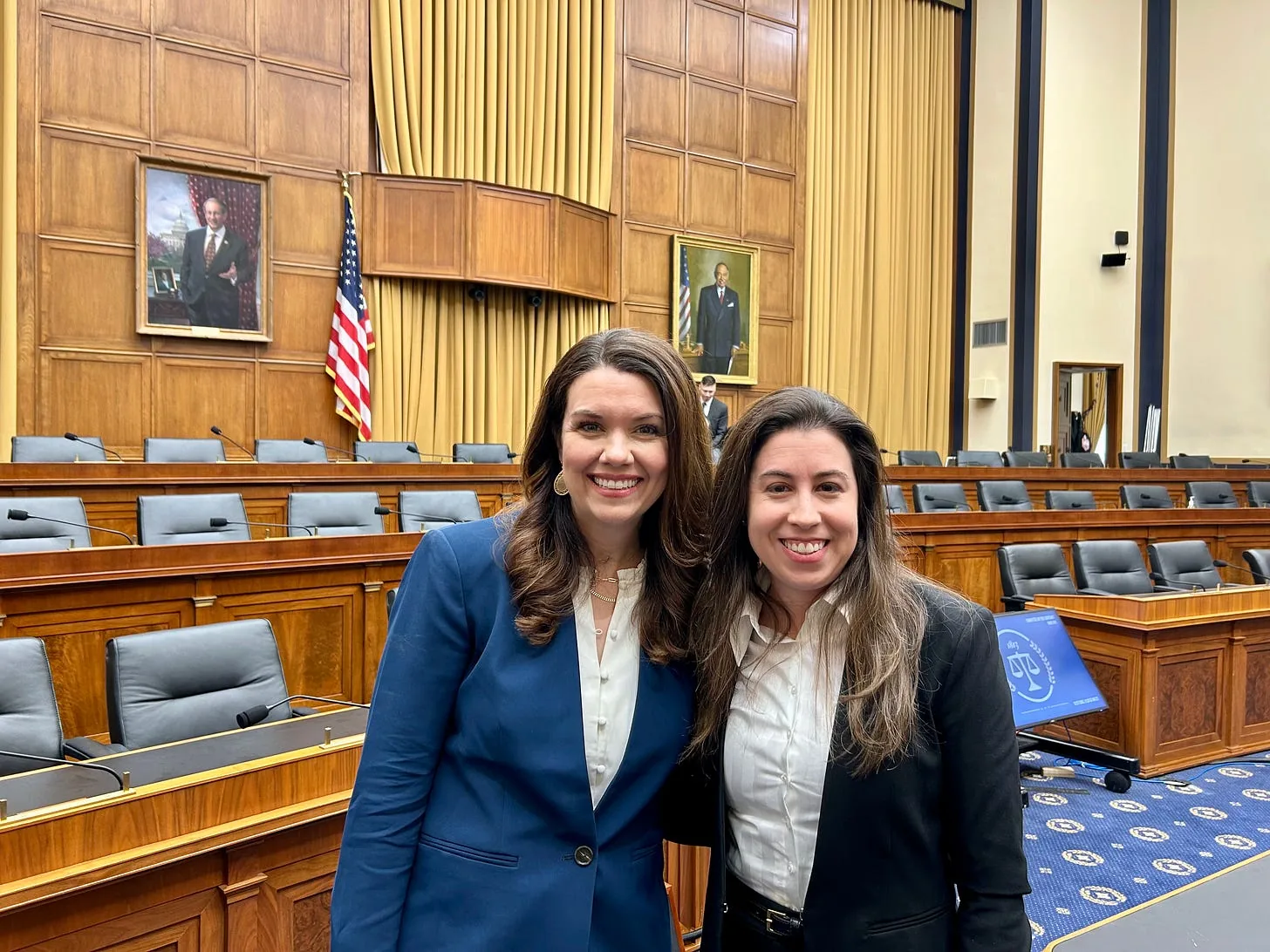
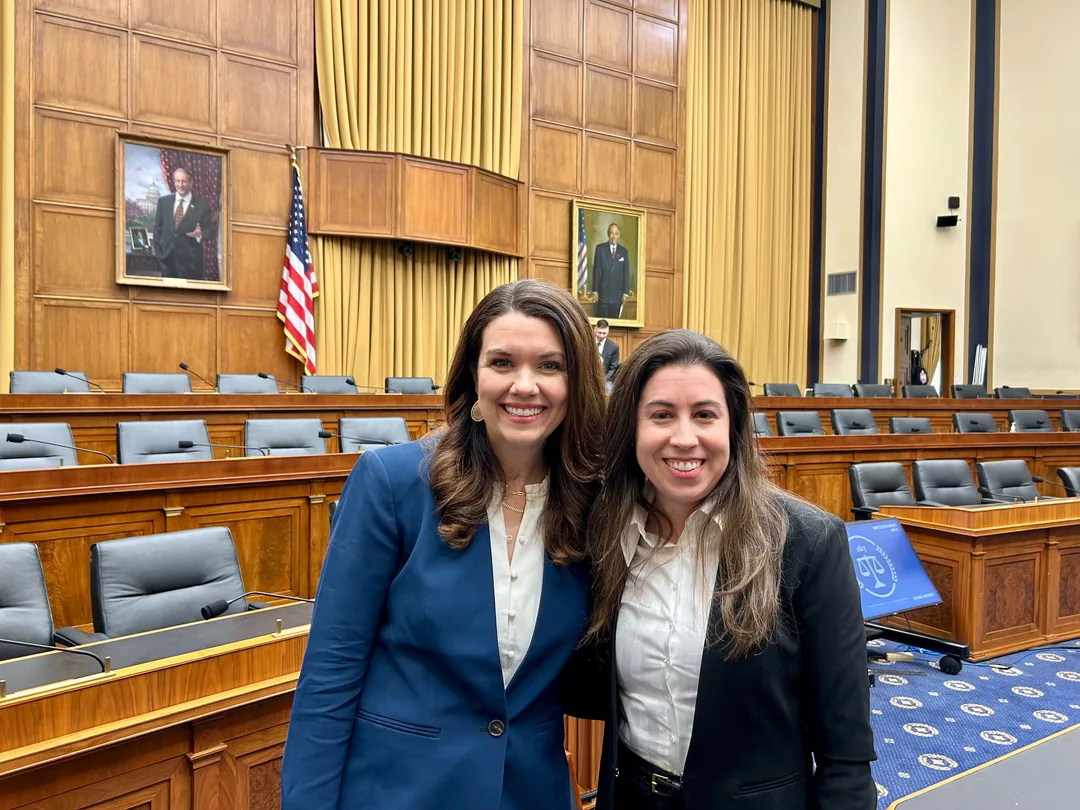
Hollie and I after testifying in a hearing on the bill.
A Stalled Bill Isn’t a Dead Bill
I picked up this fight in the fall of 2022, during the 117th Congress — six years after the bill’s first introduction. Within months, I’d lost both engines that were keeping it airborne. The House Republican who’d been carrying it had switched committees. The Senate Republican champion had retired. Without bipartisan leadership, a bill like this goes nowhere — and we’d just lost our entire Republican side.
Come January, with the 118th Congress underway, I started working through the House and Senate one office at a time, looking for new sponsors. Rejection after rejection — until Representative Russell Fry of South Carolina, who’d handled cases like this before he ever ran for office, agreed to take it on in the House. Senator Rubio signed on as the Republican counterpart to Senator Gillibrand in the Senate. By April 2024, nearly two years later, we were finally moving again — just as the 118th Congress was running out of runway.
From there, we built a coalition letter that eventually carried 103 organizational signatures, got the bill onto the agenda at several Senate policy roundtables, and ran a single Congressional briefing that did the work of weeks’ worth of individual office visits in one afternoon.
What separates a coalition that survives a setback from one that quietly evaporates almost always comes down to belief — do the people inside it still believe the effort is alive, still gaining ground, still headed somewhere real? To hold that belief together, I kept a monthly call going for grassroots advocates and sent a weekly update to keep everyone pulling in the same direction.
By fall 2024, the bill cleared the House Judiciary Committee for the first time in its eight-year history. Everything was building. Then, the night before it was due for a House floor vote, it died anyway.
But the momentum outlived the setback. Representative Fry and Chairman Jim Jordan committed on the spot to making it a top priority in the next Congress. An early hearing followed in February 2025, and that fall — in one of the most overloaded legislative calendars in recent memory — the bill passed the full House without a single dissenting vote. When Senator Rubio left to become Secretary of State, Senator Hyde-Smith stepped in to carry his half of the Senate effort, and in December 2025 the bill cleared the Senate by unanimous consent — more than nine years after it was first written.
I remember exactly where I was when it finally happened. I remember calling Hollie. Congress passed only about forty bills into law in all of 2025 — one of the lowest totals in modern history. This was one of them. It was signed into law in January 2026.
The Mechanics of Momentum
Building and sustaining momentum comes down to five moving parts, and they apply just as well to a product launch, a startup, an internal reorg, a fundraising round, a grassroots campaign, or a personal health goal.
1. Know who your champions actually are.
The real test isn’t who shows up when things are easy — it’s who’s still pushing when the whole effort looks like it’s collapsing. Supporters will say nice things about your cause. Champions treat it like it’s theirs. When the bill died at the end of the 118th Congress, Representative Fry, Senator Gillibrand, Senator Hyde-Smith, Representative Lieu, and Chairman Jordan didn’t shrug and move on — they immediately locked in a plan to finish the job in the next Congress.
Each of them brought something different to the table, and together they created enough structural strength to absorb the pressure of the final stretch. Pull one piece out and the whole thing might have come apart. Figure out, before the crisis hits, who will keep grinding without recognition through the long, uncertain middle of your effort — because that’s exactly when you’ll need them.
2. Cram the timeline instead of stretching it.
There’s a well-known principle in sales: a hundred outreach calls made in a single day produce a completely different outcome than the same hundred calls spread across a hundred days. This isn’t just arithmetic — it’s about density. When activity clusters together, each piece reinforces the others, and that reinforcement becomes visible proof to outsiders of which way things are trending. A dozen organizations sending letters in the same week. A briefing room packed with staff from twenty offices. A coalition letter landing with 103 names attached. None of that just says “this bill has support.” It says the support is coordinated and already in motion.
Coordinated, simultaneous action is itself a form of persuasion. It tells anyone still on the fence that joining now costs less because so many others already have — and that staying out costs more for the same reason. Good timing isn’t just about waiting for the right moment to appear. It’s about manufacturing that moment by packing enough coordinated activity into a tight enough window that hesitation starts to feel like the riskier choice.
There’s a neurological reason this works, too. When people watch others commit publicly — signing a letter, walking into the same room, backing the same cause out loud — mirror neurons fire in their own brains, priming them toward the same behavior. Researchers at the University of Parma first documented these cells in primates in the 1990s, and human neuroimaging studies have since confirmed the effect: the same neurons activate whether we’re acting or simply watching someone else act.
3. Never let the coalition go quiet.
People who get regular evidence that things are moving stay invested. People who feel like the effort has stalled quietly stop showing up. The hardest part of a long campaign isn’t rallying people around a big headline moment — it’s keeping them engaged through the slow, repetitive, invisible work that has no adrenaline attached to it at all.
A leader’s core job is keeping the destination in view, even when the route keeps changing and the timeline keeps slipping. Consistent updates aren’t just for morale — they’re what actually turns a loose group of individuals into something that behaves like one organization with one shared conviction. The monthly calls kept running through every quiet stretch of the campaign, every week where nothing newsworthy happened and the next milestone still felt far off. That communication rhythm was the thing keeping the engine running.
4. Break the destination into checkpoints.
Teresa Amabile and Steven Kramer’s research at Harvard Business School — built on nearly 12,000 diary entries from 238 employees across seven companies, later published as The Progress Principle — found one factor mattered more than any other for sustaining motivation: visible, incremental forward movement on something that mattered.
The neuroscience backs this up. Dopamine doesn’t spike at the finish line — it spikes in anticipation of getting closer to it. That means a single distant goal isn’t enough to carry a team through a long campaign. Dopamine is what drives people to start and keep going, not just what rewards them once they’ve succeeded — and what triggers it is the credible sense that ground is being covered, not the arrival itself.
What people need are checkpoints along the way — smaller, visible wins that prove the larger goal is getting closer. Break a big destination into a sequence of these, and you keep the whole group moving toward it.
Throughout the fight for the Trafficking Survivors Relief Act, the ultimate goal — passage — didn’t move for years. What kept people engaged was the string of smaller wins that showed up on a visible schedule: a new sponsor, a committee vote, a hearing date. Each one fired the same neurological signal that the effort was alive. The finish line kept sliding further out than any of us wanted, but it never disappeared from view, and we could always see it getting nearer. Two steps forward and one step back is still forward.
Ask yourself: does your team actually know what winning looks like at each stage? If the target is too vague, the brain has nothing to reward itself against, and momentum has nowhere to attach.
Here’s the underlying point: a coalition that feels like it’s losing isn’t just demotivated — its members are, quite literally, less capable of the clear strategic thinking that might turn things around. That’s why communication in a long campaign isn’t a nice-to-have. It’s the difference between keeping people’s brains in a state of forward-looking anticipation versus a stress response that shuts down exactly the kind of thinking you need most.
When momentum does die, there’s no clever workaround — you go back to the fundamentals: fresh checkpoints, a renewed communication rhythm, and if needed, new champions.

Hollie and I with a signed copy of the Trafficking Survivors Relief Act.
Applying This to Your Own Goals
The same mechanics work whether your “coalition” is thirty organizations or just you. Dopamine, stress hormones, and social proof don’t care about the scale of the effort.
Compress your effort instead of spreading it thin. A resolution to “exercise more,” stretched evenly across a full year, never builds enough density to feel real. Three weeks of daily walks does more for your brain than twelve months of vague good intentions, because concentrated action is something the brain actually registers — diffuse intention is not.
Find someone to mirror. Sign up for a class, join a run club, or just send a friend a photo of the drawer you finally cleaned out. Watching someone else’s visible progress — or having them watch yours — triggers the same commitment response that moves a coalition member off the fence. It only takes one other person to make quitting feel like breaking a promise instead of missing a private target.
Track it, even if no one else sees. A coalition that stops hearing updates disengages — and so do you, on your own. A habit tracker, a weight log, a visible tally of practice hours all tell your brain the project is still alive. Even silence directed only at yourself reads as the effort stalling out.
Set checkpoints, not just destinations. “Lose thirty pounds” gives your brain nothing to reward in the short term. “Lose two pounds this week” does. Small, concrete, near-term targets are what make a distant goal feel like it’s actually approaching, rather than fixed and far away.
Notice your own version of the stall response. A plateau, a stalled project, two missed weeks of practice — the instinct is to read this as failure and quietly walk away. That’s the exact same stress response that guts a struggling coalition’s ability to think its way forward. The fix isn’t more willpower — it’s the same reset that saves any stalled campaign: a new near-term checkpoint, a visible way to track progress again, someone new to mirror.
Front-load your effort, cluster it into short bursts, keep a visible record of progress, and get someone else in the loop with you. That’s the formula for staying in motion.
Power Principle: Momentum has to be built and actively maintained — otherwise even the strongest strategy eventually stalls.
Identify real champions, not just supporters.
Compress activity instead of spreading it thin.
Keep everyone in the loop.
Build checkpoints, not just a finish line.
Exercise: Map Your Own Momentum
Pick something you’re leading, or want to lead, that will require sustained effort over time. Work through these before you build the plan.